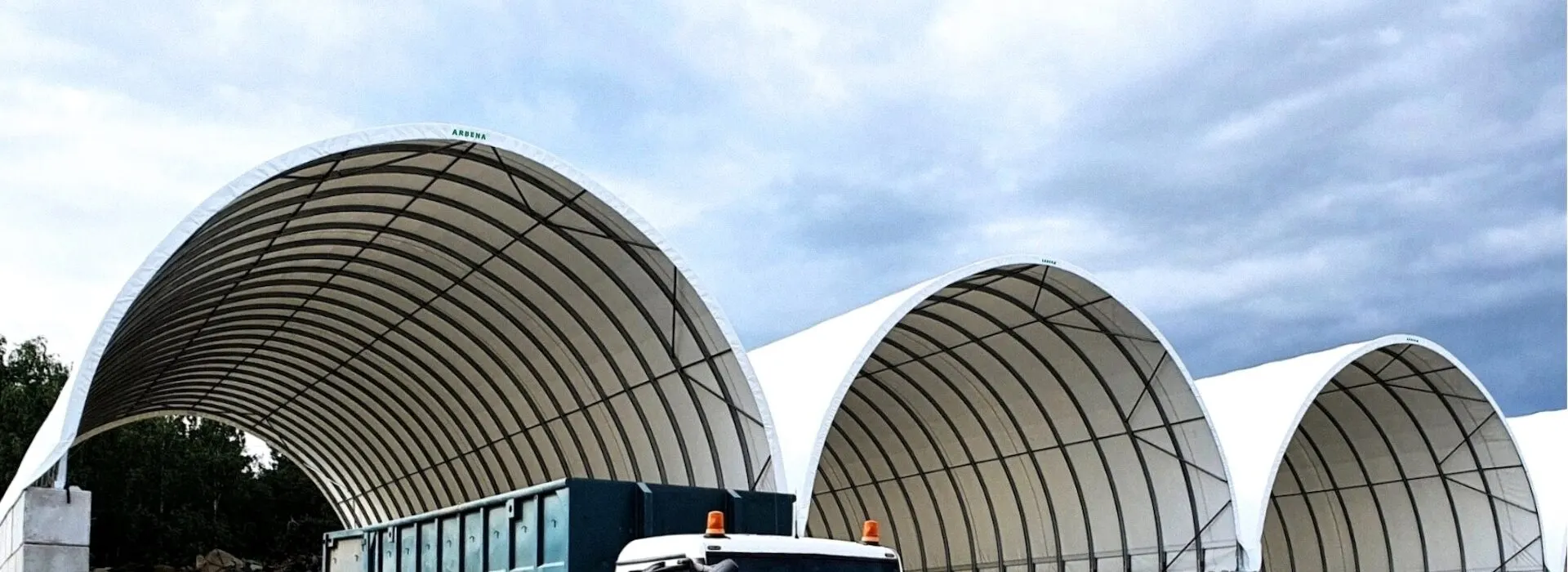
There are many simplifications around year-round fabric buildings. Some buyers assume that a building that stands through the winter is already a year-round building. Others believe a fabric building is by definition only suitable for seasonal use. Neither is quite right. Whether a building is truly year-round depends not on the name of the technology, but on how it was designed, calculated and what it is used for.
The same type of building can serve as a machinery store, a materials store or a livestock building, provided it suits its function and conditions of use. It is also worth separating two terms that are often confused: a year-round building does not have to be insulated.
Can a fabric building be used all year round?
Yes, but not every fabric building becomes a year-round building just because an offer says so. What counts are its parameters: the structure, the way the loads are calculated, the quality of materials, the covering and how well the building is matched to its location. A building that has to work all year must be ready for snow, wind and regular use regardless of the season.
All ARBENA buildings are designed for year-round use. They are calculated for the snow and wind loads at their specific location, and are intended for regular use throughout the year, not just to last until the next season.
What sets a year-round building apart
A year-round building is not designed for occasional use. It has to work twelve months a year and behave predictably in any weather. That changes what matters:
- how the structure was calculated,
- which materials were used,
- how the covering performs,
- how the membrane is tensioned,
- how the steel is protected against corrosion,
- and whether the whole building was matched to its site.
When does a year-round fabric building make sense?
Wherever the building has to work regularly all year, but the investor does not want or need a conventional building. It works well when the following matter:
- a short lead time,
- functional space,
- a building tailored to a specific use,
- a reasonable entry cost.
Flexibility is often important too: the building can be matched to current needs and developed further as the business grows.
Storage, agriculture and equipment
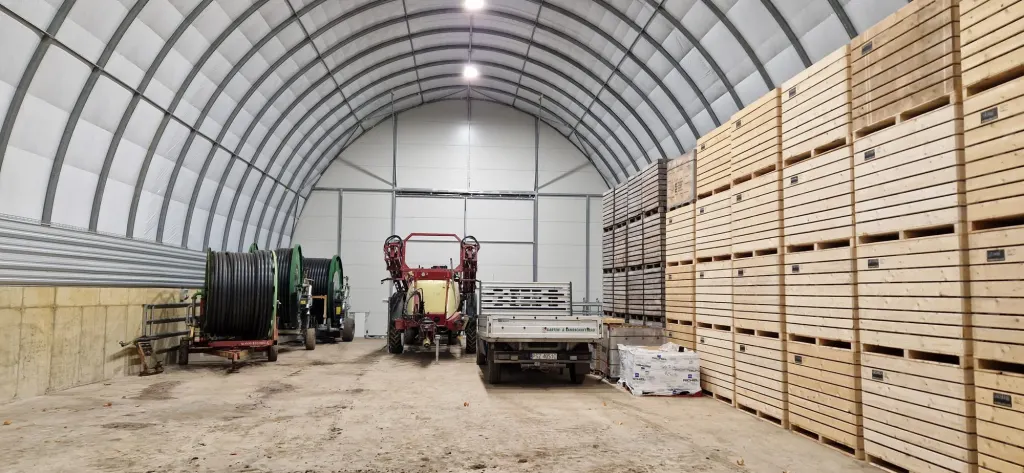
Storage is one of the most natural uses: machinery, raw materials, components and technical equipment need a dry, sheltered and accessible space in every season. On farms, a year-round building can store machinery, feed, straw, hay, fertiliser or equipment, and often supports livestock buildings or organises the farmyard. See our agricultural buildings.
Does a year-round building need insulation?
No, and this is where most misunderstandings arise. Year-round means the building is intended for use throughout the year and meets the structural requirements for local conditions. Insulation is a separate decision that depends on what happens inside.
Many year-round buildings have no insulation at all, and that is a conscious choice rather than a shortcoming. For storing machinery, equipment or materials, protection against rain, wind and snow usually matters more than keeping a heated-building temperature. Insulation should answer a real need, not be added automatically.
When an insulated building is worth it
- people work in the building on a regular basis,
- the stored materials are sensitive to temperature,
- the building has specific process requirements,
- reducing heat loss makes economic sense,
- insulation clearly improves day-to-day working conditions.
What to check when choosing a year-round building
Check whether the building was actually designed for year-round use, not just described that way. The key points are:
- structural calculations for the specific location,
- resistance to snow and wind,
- steel quality,
- durability of the covering,
- the membrane tensioning method,
- corrosion protection,
- quality of installation details,
- options for service and later extension.
ARBENA uses a 650–670 g/m² membrane with a 10-year warranty under the applicable terms and a white inner face that brings more daylight into the building. A heavier membrane alone does not give the user a real advantage and adds unnecessary load to the structure. The tensioning system on mounting straps keeps the membrane evenly tensioned, without slack, rippling or flapping. On the structural side, ARBENA uses HX420 steel, oval FT profiles and Magnelis® protective coating. More on our technology page.
Year-round fabric building or conventional building?
It depends on the function, budget, timescale and how much flexibility you need. Conventional construction has its place and is often the natural choice, but it is not always necessary. For a warehouse, a machinery shed or a store needed quickly, a year-round fabric building can simply be the more rational option. Its advantages usually show in three areas: lead time, flexibility of the investment and a lower entry cost while keeping full functionality. A well-designed building does not have to be a stopgap; it can work for many years.
How to avoid overpaying
Start from the function of the building, not from the labels. The use decides whether you need insulation, which gates are required and which parameters really matter. The easiest way to overpay is to buy “just in case” instead of matching the building to real needs.
Not sure whether your building needs insulation? Tell us how it will be used and where it will stand, and we will help match the configuration to your needs.