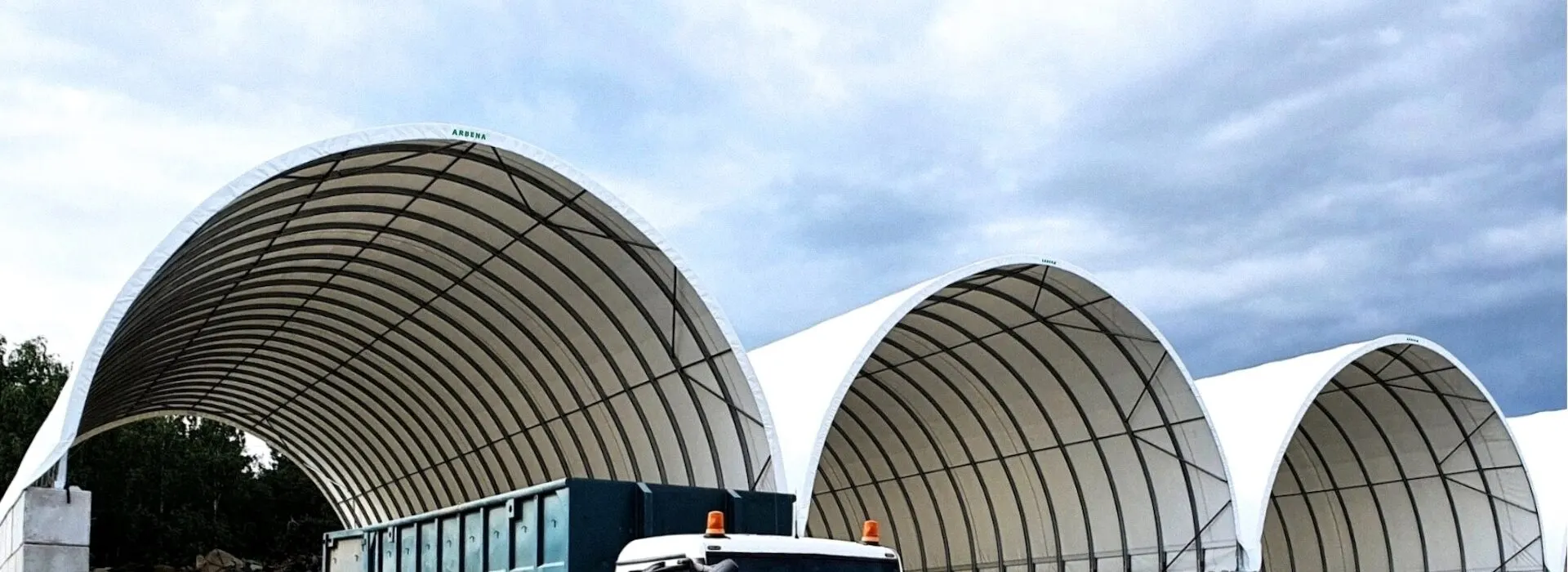
The question of the right size for a straw and machinery building comes up all the time, and the answer is rarely just “take 10 by 15” or “12 m is best”. It depends on what exactly you want to store, what equipment you load with and how much room you have on the yard. That is why a bale store should not be sized only by the number of bales. Day-to-day work on the farm, and whether the building will later also house machinery, matter just as much.
How much space does a bale take?
The most common round bales are 120 to 140 cm in diameter, with 120 cm often used as the reference, and about 120 cm long. A bale does not always keep its exact size after leaving the baler: straw expands and the ground under the building is rarely perfectly level. Treat any capacity figure as a guide for a tidy, well-planned layout rather than an exact count. A few centimetres per bale, multiplied by a whole row and the full length of the building, make a visible difference.
How many round bales fit in one cross-section?
For round bales, what counts is not the floor area but how many bales can be stacked across the width and along the length. The width and height of the building, together with the bale diameter, decide how well the space is used.
| Building width | Bales Ø120 cm | Bales Ø150 cm | Bales Ø170 cm |
|---|---|---|---|
| 6 m | 7 | 5 | 3 |
| 8 m | 16 | 10 | 7 |
| 10 m | 26 | 16 | 12 |
| 12 m | 35 | 22 | 16 |
| 15 m | 63 | 37 | 30 |
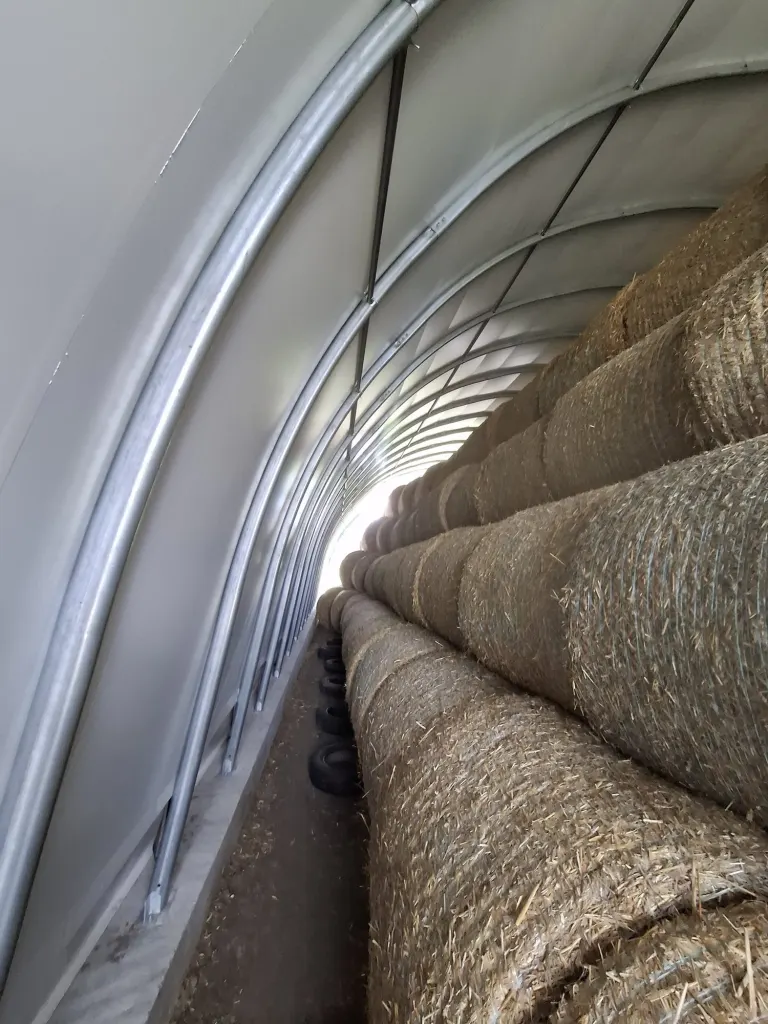
With a 15 m long building and 1.2 m long bales, you get about 12 rows. A 10 × 15 m building therefore holds about 312 bales of 120 cm diameter, and a 10 × 30 m building about 624, assuming an even layout. With 150 cm bales, a 10 m cross-section takes about 16, so the totals are lower.
What a bale store has to do
A building for straw or hay must above all keep the material dry without making daily loading harder. In practice, many farms do not lay a full floor slab. For straw stores, the building is often anchored directly to the ground, with a gravel bed or slightly raised ground inside to limit moisture rising from below. Some farmers also stack bales on pallets. This keeps the building easier to relocate if needed.
Many farms keep bales under fleece covers. It looks simple, but in strong wind the cover slips or lifts and has to be weighed down again, and covering a stack means walking on the bales, which is not safe in snow and frost. After winter, the outer layer is often damp, frozen or partly rotten. A building removes these problems and makes straw easier to handle every day.
- Protective panels along the lower part of the walls are worth fitting, because the bottom layers of straw tend to push outwards. Bales pressing directly against the membrane can stretch and weaken it over time.
- Windbreak netting needs some thought: netting brought down low gives better rain protection, but can get in the way when bales have to be stacked high near the entrance.
- Drive-through buildings work well for straw and hay, because natural airflow keeps the material drier. This option is usually also more economical.
- Closed gables are the better choice where biosecurity matters, for example near large poultry houses.
Choosing the width and height
The right size depends not only on the number of bales, but also on the length and width of the yard and on the loading equipment. With a short but wide yard and a telehandler, a wider, higher and shorter building can be the better investment, because it uses the height. If you work only with a tractor and front loader, which usually lifts to about 3.5–4 m, a very high building will not let you use its full volume.
Ridge heights of standard ARBENA buildings:
- 6 m wide: 3.2 m high,
- 8 m wide: 4.5 m high,
- 10 m wide: 5.5 m high,
- 12 m wide: 6.5 m high.
These proportions show why width alone does not tell the whole story: the combination of width and height decides whether bales can be stacked in several layers and the whole arch used. When comparing offers, check the inside of the structure too. Where load-bearing members project into the building, as with some truss designs, it is harder to use the full width and height for stacking or for manoeuvring machinery.
Square bales use the space more efficiently because they stack more tightly and fill the areas along the walls. Most farms, however, store mainly round bales and size the building for them; square bales, machinery or trailers then fit easily.
A building on walls
A building raised on walls is more versatile, though less mobile. It gives more storage along the sides and suits farms that also want to store other materials, such as grain. Walls alone do not add much capacity when round bales are laid on their side, because the stack still forms a pyramid. The difference becomes clear when bales are stood upright like columns, which allows several layers along the walls.
Space for the combine, tractor and sprayer
A building bought for straw often takes on a second role. As bales are used up, the free space becomes room for equipment, and this is where a building with some margin pays off. Machinery cannot be stacked, so if the building is meant to combine both roles, choose its width and height with more room to spare. See also our solutions for machinery storage.
Entrance width and height
The most common mistake is to look only at the external dimensions of the machine. The turning circle, cab height, attachments and the space for manoeuvring in front of the building matter just as much. Handling a bale at 5–6 m inside a building also takes much more precision than in the open. Treat minimum entrance dimensions only as a starting point and add a reserve, especially if you plan to change your machinery in the next few years.
A combined bale store and machinery shed
Combining storage and garaging is possible, but not in every form. Trailers and other unpowered machines can be stored with straw without problems. Engine-powered machinery is a different matter: keeping it next to dry straw increases the fire risk, because any fault or self-ignition is made worse by the bales. A combined building makes sense, but it should be planned deliberately, with separate zones and safety in mind.
Planning for extension
A building can be extended later, but this almost always costs more than building the larger size from the start. The most common mistake is buying a building with no margin; the opposite mistake is choosing a wide, high building without the equipment to use it. Price per square metre is not the only criterion either: transport, installation and travel costs are largely fixed, so small 6 or 8 m buildings are not always the most economical choice.
Summary
The best bale store is not the one that looks best in an offer, but the one that fits your farm. The number of bales, your equipment, the layout of the yard and the planned use should be considered together. The same number of bales can mean a long, narrower building for one farm and a short, high and wide one for another. More about farm buildings: crop and feed storage.
Not sure which size suits your farm? Send us the number of bales, your loading equipment and the yard layout, and we will suggest whether a wider, higher or longer building will work better.